Monday, January 5, 2015

Serving in Italian

For our final action project in the Fare class, everyone came up with ideas of how to engage our understanding of the Italian language, along with the knowledge we gained from the cooking portion of the class. We decided to invite people from the city to a dinner provided by us. Guest will be served Italian dishes made by some GCE cooks, but also get a little intro into the language. I have agreed to be a server in this dinner, along with 3 other classmates. With taking on that role, I am responsible for serving, and teaching the guests some small Italian expressions.

I would begin with the expressions, by teaching them how to introduce themselves in Italian, along with stating how they’re feeling, and where they are from. I would then move on to teaching them the name of the meal they’re about to eat, and how to order it in Italian.

Below is a conversation between a customer ordering in Italian.

Cameriere (server): Buongiorno
Cliente (customer): Buongiorno. Vorremmo un tavolo per due. (Hello, we need a table for two.)
Cameriere: Accomdatevi. Questo e’ il menu.
Cliente: Grazie
Cameriere: Che cosa predete da bere? (what would you like first?)
Cliente: lo vorrei…. ( I would like)

Asking for the bill: This is something the customer must ask for first, because in Italy it is considered rude for the server to bring out the bill first.
Cliente: Cameriere mi scusi! Il conto per favore.
Cameriere: Questo e’ il conto.
Cliente: Grazie.


Sunday, December 14, 2014

Fruitvale Station: Movie Critique

In the second unit in the Ollywood class, which is called Production, the class learned about the elements that are actually represented in a movie. Those elements include, the cinematography, lighting, actors/actresses, stage/costume design, and the different types of framing directors decide to use. For our action project the class was assigned to complete a movie critique in video form with a partner. My partner and I decided to critique the movie Fruitvale Station. A story about a young man living in Oakland with a small family, and a day that was supposed to be filled with fun, was filled with tragedy instead. Critiquing the film was enjoyable. The list provided to us was filled with good movies, so it was tough to choose. The movie was so good, that I forgot I was doing a project. At first I had a difficult time trying to create a script for the video, but once me and my partner practiced and kept going over it, everything went well. Thanks to his unit, I know now all the steps that need to be taken care of when actually producing a movie. This project also taught me how to correctly write a movie critique.


Below is the video of me and my partner discussing Fruitvale Station. Hope you enjoy!


Wednesday, November 19, 2014

The Secret In Their Eyes.

In the first unit of the Ollywood class, which is called Pre-Production, the class learned about what must be done in order for the cameras to start filming. We went over the importance of production and costume designers. We also went over John York’s elements that make up an excellent screenplay, which includes a protagonist, antagonist, the desire, external, internal desire, the inciting incident, the journey, the crises, the climax, and the resolution. For our first action project, we chose a movie from a list provided by our teacher and critiqued it in the eyes of a movie critic. I chose The Secret In Their Eyes, an Argentine crime thriller film. At first, I had a hard time understanding the movie because it was all in Spanish, but once I found a version with English subtitles, I knew I was going to enjoy what I was watching. Thanks to this project and unit, I now watch movies differently, but in a good way. A way that gives me a more clearer understanding of how a movie is written, and how important the people working behind the scenes are.
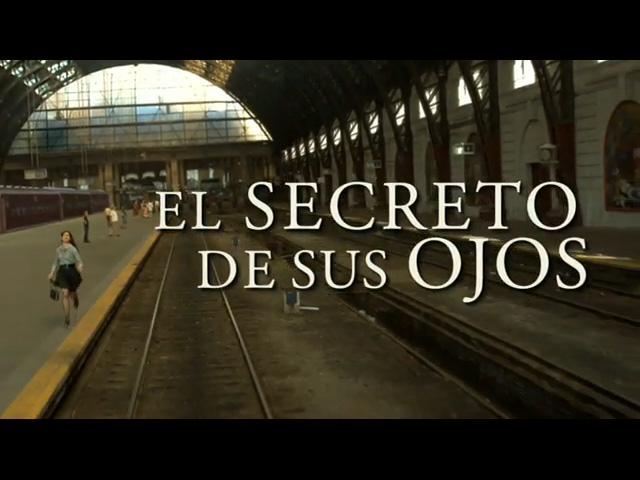
6870891624_1c96156270_o.jpg
Lenox, Susan. "The secret in their eyes". Flicker. Yahoo! 26 March. 2012. web 14 November 2014


The Secret In Their Eyes was released in 2009. The movie follows the story of a retired judiciary employee, Benjamin Esposito played by Ricardo Darin and a judge who worked together 25 years before. The movie is based off of the Argentine crime thriller novel, La Pregunta De Sus Ojos (The Question In Their Eyes), by Eduardo Sacheri. , The Secret In Their Eyes was produced, directed and edited by Juan Jose Campanella. The story goes into a time period in Argentina known as the Dirty War that lasted between 1975 to 1983. It was a time when Argentina’s dictatorial military wanted to keep their power, so they often tortured and killed people who were against them. It was also a time when criminals were often freed and left unpunished, which also led to violent times in Argentina.

The movie takes place in Buenos Aires in 1999. Benjamin, a retired criminal investigator is trying to relive his past in his head because he wants to write a novel about the rape and murder case of Liliana Coloto played by Carla Quevedo that took place in 1974. In order to do that, he must reconnect with Irene Menendez-Hastings played by Soledad Villamil, whom he worked with during the investigation of Coloto’s case, to get her opinion on the novel. We are set back into the ‘70s when Irene starts reading the novel in forms of flashbacks. The first flashback we see is when Benjamin first saw Irene. Benjamin still remembers her as the young lady recently graduated from Cornell stepping into the office during the summer of 1972. He paid attention to her tall figure, silky hair, and of course beautiful eyes. Irene always looked very professional, but also stylish. She often wore dresses with easy-going colors, or dress suits, which went well with her stubborn, yet outgoing personality. Benjamin, a young investigator who always wore his grey trench coat and fine suits, showed that he was serious and ready for his job. But he was also young and always had good, cheesy, pickup lines for any good-looking lady that he laid eyes on, yet Irene left him speechless. Through the flashbacks we learn that the murderer was found, freed and even had an encounter with Benjamin after, but Benjamin didn't have the power to arrest him, so the killer was never seen again. Now walking into his former office, we get to see how both Irene and Benjamin aged after 25 years. Irene is seen with shorter hair, glasses, and a longer dress suit, with pictures of children on her desk, indicating that she now has a family. Benjamin on the other hand has no family of his own, has some grey hair, longer beard, and dressed more casual than professional. The costume designer and makeup artist did a fantastic job of making both characters seem older, with little things like their hair, attire, and even props like the picture to show the lives they’ve lived apart from each other.

While trying to track the murderer down during the ‘70s, Benjamin and his partner, Sandoval had many setbacks. The movie’s antagonist,Counselor Romano played by Mariano Argento, an arrogant character wanted to get the case over with, so he accused and beat a false confession out of two construction workers. Raging with anger, Benjamin confronts Romano by stating that he’ll never step foot into the offices again once he puts in a complaint. Romano responds with “You have no clue with who you’re messing with.” Benjamin and his partner, Sandoval quickly got back on their feet by reopening the case with Irene’s permission. Although always drunk, Sandoval was still a smart detective and gave Benjamin an important lead to the case. The climax happened when Benjamin finally had the murderer sitting right in front of him. Bejamin and Irene were trying to get the murderer to confess, but because of what was going on in Argentina at that time, the government let him go, something not even Benjamin had the power to change. Sandoval’s advice would also no longer be there to help him out, which puts Benjamin in a state of denial, and closes hope for him.

Irene asks him why he’s writing a novel and going back to his past, and he responds “You see? I don't want to miss another chance. How is it possible? How can I do nothing about it? I've been asking myself for 25 years and I've only been able to come up with one answer. "Forget it, it was another lifetime. It's over, don't ask." It wasn't another lifetime. It was this one. It is this one. Now I want to understand. How can someone live an empty life? How do you live a life full of nothing?” This quote shows the protagonist’s frustration and how the open case has affected his life in the past 25 years. . Re-living the case revived his desire to find the murderer with Irene. He must start a new journey of tracing this man with new tips and some he had used 25 years before.

My favorite scene shows the love that Irene and Benjamin had for each other during the ‘70s. It seems like a classic love story ending, but it wasn't until this scene that Irene finally showed her true feelings for him by chasing the train that he was leaving on. . While on the train, Benjamin runs to the rear to get a last look back at her. In his novel, Benjamin describes that scene, “He ran to the end of the train and watched as her figure, once gigantic, now shrank in his eyes, but grew more than ever in his heart.” I thought this piece of dialogue was a great way of showing how much love Benjamin still has for Irene even though he never saw her again until 25 years later. The resolution scene was very shocking, something that I didn’t imagine would happen . Benjamin finally finds out whether the murderer is alive with the help of the victim’s widower, and the love between Irene and Benjamin finally take a major step forward.

The production design team did a pretty good job depicting the settings, especially Buenos Aires, where the office is in. They portrayed a city with huge corporate buildings and cafes, on what it seems like every corner. The other setting is a small town, Chivilcoy was also very well designed. There weren't huge buildings, but rather small houses and businesses surrounding, with stray animals walking around. The people walking around were dressed differently from the city garb of Benjamin and Irene. They had presentable clothing, but less professional. Old women had dresses and head scarves, unlike the women in the city who had dress suits on. The costume designer also did a nice job depicting the fashion scene in the ‘70s. Irene was always seen with her loose long silky hair, along with her dresses. The costume designer also included popular colors during that time, including many browns, yellows and light greens. The designer made sure to include props like a record player, a typewriter and many Polaroid pictures and cameras to give off a ‘70s vibe. The film was tied into the setting of when the Dirty War was taking place in Argentina. I think the writer did a great job tying that horrible time period into the movie when the murderer was let go and never found again. I also think the camera crew did an excellent job of getting close-ups of the character’s eyes in some scenes knowing that there are many secrets, showing the inspiration for the movie title.

Juan Jose Campanella has gotten great feedback and rewards from Spain and even Hollywood. The Secret In Their Eyes received an Oscar for Best Foreign Language Film in 2009, making it the second Oscar award that Argentina has won, with the first movie winning an award in 1987, also done by Campanella. Overall, I was surprised at how much I enjoyed this movie and I wonder if I’m going to enjoy it as much when the new American version comes out, starring Gwyneth Paltrow and Julia Roberts. Everyone in the movie played their part well, including the people working on set and behind the scenes. The director did an excellent job of secretly tying an unfinished love story and murder case together leaving the audience eager to find the next part of either story.

Sunday, October 26, 2014

Can we handle an outbreak of an illness?


In the last unit in the Population class, which is called If/Then, the class went over the human population and tried to predict what the human population would be by 2050. We tried to predict with a method in math called geometric and arithmetic sequence. For our last action project, the class was asked to create a script discussing a topic that has something to do with the human population growth. The discussion had to include 2 viewpoints that was supported by evidence and real hard facts. To include the math in this project we went over, we used a geometric sequence to figure out what the human population would be in 2050. At first, I had a hard time using the geometric method, but then the whole class went over that part and I had a more clear understanding of how to use it. I also had a difficult time choosing a topic to discuss because there were so many good ones to go over. I was proud at how I went over this unit. When I had a hard time on one topic, I would take some time and go over that topic once again and just take time to focus. Thanks to this project, I now understand what the world could possibly look like if the human population became overwhelming.

Right now the human population is estimated to be about 7,125,000,000. By 2050 my class predicted that it could reach 10,715,465,520. We came up with this number by using a geometric sequence. The work is shown below.


AMK. Geometric Sequence. Photography. 2014


If the whole human population were to be crammed together in the city of L.A, many problems would develop along the way. One of those problems for example would be the outbreak of an illness. If you think of all the problems we already have in the world today, do you think we can handle an outbreak of an illness with the whole human population being so crammed together? Vaccines are available, but are also limited. That means people would be in a competition because everyone would want to get the best health care treatment they can possibly get, but its possible that since everyone wants a vaccine they can eventually run out.

Below I have a discussion between Kelly and Kate, going over the topic of the human population and the outbreak of an illness. At first they have different views, but when one goes over true facts, the other is leaning towards the other side.

Kate: Do you want this water?


Kelly: Nah. Just spill it out.

Kate: I think I’ll just drink it then.

Kelly: Why if you don’t want it?

Kate: It makes me feel guilty, because you know, there are many people that don’t have the access to it.

Kelly: True.

Kate: Did you know there are 3.4 million people who die in the world each year because they don’t have access to water, which can result to many diseases.(1) Not to mention that 1 million don’t have access to health care. (3)

Kelly: I know, but that usually happens in developing countries where the population of people is too much to handle and their aren't enough resources for people.

Kate: Well, put yourself in their shoes. Did you know that the whole human population can fit in the city of L.A? So imagine being stuck with 7125,000,000 people with the population reaching 10,715, 465, 520 by 2050 and maybe not having enough water and then people getting diseases while you have nowhere to go to get away?

Kelly: I mean like you said the whole human population would be in the same place, so why don’t the best doctors from around the world come up with new medicines and vaccines to cure these diseases?

Kate: They wouldn't be able to handle it! Like I said before millions are already dying and that’s with people using different water sources. If we used the same source eventually we would run out of it.

Kelly: Not true! Earth has enough quantities of water in our lakes, oceans, rivers and even in our atmosphere! (5)

Kate: Alright then. Well, think about the health care system? People from all over the world would be stuck together. That means that many people would be coming from countries with diseases like Malaria and yellow fever, which will catch on to people and then spread.

Kelly: But there are immunizations that fight against 27 diseases, plus there are also vaccines that are available to travelers that travel to countries that have diseases like Malaria and yellow fever. (2)

Kate: It wouldn't work! For example think about the Ebola outbreak that just made its way here.

Kelly: Exactly. Doctors are already coming up with vaccines for it.

Kate: Right. But only 4 people have been recorded having that disease here, and everyone is already feeling overwhelmed.

Kelly: The CDC and health care providers are preparing though. They know what to do. (4)

Kate: Not really. Think about it. 2 of those diagnosed people could have been prevented if the hospital was prepared enough.

Kelly: But eventually it’ll stop. Remember the swine flu? We got over it.

Kate: It’ll be hard to get over it when the whole human population is crammed together. Whatever bacteria and virus is in your body will have easy access to many other bodies that will just keep growing. Too many people die from illnesses in the world and this is without everyone being crammed together, so imagine the whole human population being contaminated in a large city, do you really think we would be able to handle this? 


Kelly: Maybe you’re right.


Citations:

1. "Water.org." Waterorg. NP, n.d. Web. 22 Oct. 2014.
2. "Immunization Issues." Vaccines in Development. National Network for Immunization Information, n.d. Web. 24 Oct. 2014.
3.Shah, Anup. "Health Issues." - Global Issues. N.p., 27 Sept. 2014. Web. 21 Oct. 2014.
4."Questions and Answers on Ebola." Centers for Disease Control and Prevention. 23 Oct. 2014. Web. 23 Oct. 2014.
5. Webster, Jim. "OLogy." OLogy. Ask A Scientist, n.d. Web. 25 Oct. 2014.\


Thursday, October 23, 2014

My Hero's journey

In the last unit in the Stories class, which is called Journeys, the class went over and learned about the steps that make up the journey of a hero. For our last action project, the class was asked to analyze a fictional hero and also interview a real life hero. We created a slideshow on paper presenting all the steps to the fictional hero’s journey, and created a transcript that holds the interview of our real life hero. Like my previous projects, it was tough choosing a hero to analyze, but after brainstorming many qualities that a hero needs, I easily was able to choose one. I was actually surprised that I enjoyed watching my hero’s movie all over again, all while writing about the different steps in her journey. While going through the steps I think I’ve noticed many things that I hadn’t noticed before. In the process of creating this project I had a tough time with the slideshow and trying to present the steps of the hero’s journey because I didn’t want to inaccurately represent what the hero went through. I got over that situation when I carefully went over the different steps and just took some time to focus, which is something that I’m proud of. Before this unit I didn’t even know that a hero had steps in their journey in order to become the hero they are today. Thanks to this unit and project I now have a better understanding of how an extraordinary journey can shape a person into a hero.


The two heroes who I chose were Mulan and my aunt IA, with Mulan obviously being the fictional hero and my aunt being my real life hero. I chose Mulan because although she is very clumsy and silly, she is still very brave. She stood up when she knew she needed to. Mulan was scared, but her courage gave her a chance to prove who she really was on the inside. Being surrounded by men who thought little of women must have been tough for her while fighting a battle, but at the end she ended up winning the battle and gaining victory for China again. I chose my aunt as a real life hero because of what she had to go through while battling Leukemia at a young age. Just like Mulan, my aunt was young when she had to become strong. Both were also very scared, but both were also very courageous.They went through many tough events before things got better, and it was because they both believed in themselves. Just like Mulan, my aunt won a battle that she didn’t think she would win in the beginning.

Below I have the slideshow on paper showing Mulan going through her journey into making her a hero. Which include the 8 steps of The call, Mentor, Crossing the threshold, Trials, Infinate Despair, Rebirth, Atonment, and The Return.


RD. Mulan's adventure. Photography. 2014 


Real life Hero Interview:
Q:What are some other reasons why others look up to you?
A: People look up to me because I'm a 2x cancer survivor. I started fighting cancer at the age of 19 and I didn't realize until then how strong of a person I really am.


Q:Who would you say most helped you decide what you wanted to do?
A: Dealing with what I went through being around nurses, doctors, and just being around the healthcare industry  helped me decide that I wanted to pursue a career in nursing, which is why I'm in nursing school now.
Q:Do you think this new job is for you?
A: I think nursing is for me because I know what is expected from a patient because I used to be one. It will be easy for me to empathize with other patients, and I want to give back to others what was given to me.

Q: Along your way, did you know anyone that was going through the same thing as you?
A: I never knew anyone going through the same thing I was going through, which made it pretty scary because I didn't know what was going to happen. But I had to remain strong and positive and hope for the best.


Q: What were the greatest challenges you’ve faced throughout your life?
A: The biggest challenge I faced was fighting for my life.
Q: How did it change you for the better?
A: It changed me for the better because it made me realize not to take life for granted. I saw this challenge as a little blessing in disguise, it made me appreciate everything in my life so much more.


Q: What did the challenge consist of?
A: The challenge consisted of fighting for my life, staying in the hospital for months, getting different treatments, all while trying to stay positive.


Q: What skills have you held on to that still help you today
A:Its taught me to keep my head up and to stay positive through everything. Not everything is as bad as it seems, and that other people are going through worse things.


Citations:
Mulan. Dir. Tony Bancroft and Barry Cook. Prod. Pam Coats. 1998.
Mulan10. Mulan. Photograph. 2012
The-Corngobbler. Mulan Poster. Photograph. ND
Hazelnutsandcream. Mulan and Ling Shang. ND
Mulan in Armour. Photograph. ND

Tuesday, October 14, 2014

Shiba Inu


In unit 2 in the Population class, which is called From/to, the class learned about the many differences that animals carry. We also went through Darwin and his theories on Natural Selection. The class went through the debate on evolution also. For our second action project we were assigned to choose an animal that we think will survive in Mars, based on the animal’s different traits. We made a video, saying why we think this animal will survive, and be the best fit for Mars. This also went over the topic of how some animals are more fit than others, which gives them a better chance to survive wherever they’re put. For the math portion of this unit, we went over central tendencies, box and whisker plot, and standard deviation. To include those in this project, we were assigned to choose an animal from a petshop and record data of the same species. I had a difficult time choosing an animal and figuring out why they would be the best fit, but after researching everything went well after. The math portion was easy once I collected all the data because the class would go over those topics until we were all confident with it. Thanks to this unit, I now have a more clear understanding of how the many different traits that animals carry help them survive, and be more fit than other animals.


Mars is a dusty, dry, and cold place. But underneath all the rocky surface there is ice. That means that there at least had to be some source of water at some time. Scientist are wondering still if the ice came from precipitation or if it bubbled up from a surface. As scientist began their research, they discovered that Mars could have once been a tiny snow globe. The far distance from the sun is a result of the harsh, cold weather. Also Mars having no clouds to trap heat in results in cold weather ,too. Mars is covered with rocks and ice caps. With that being said, an animal with a thin fur coat would not be strong enough to handle the climate. Also the thinner the animal, the less it would be protected. Chubby animals have more fat on them to keep them warm, whereas thinner animals would not have enough fat. Longer hair would also be able to protect the animal like a blanket, while shorter hair wouldn’t be much protection.


I chose a Shiba Inu. This breed is native to Japan’s mountainous area, which means they are good hunters, and do well in cold weather. They are also #4 on the best dogs that adapt well to cold weather, because of their thick fur.  


Script:
Many dogs have the ability to adapt well to cold weather, but none do it as good as a Shiba Inu. A Shiba Inu is a great candidate for a chance to go to mars, because of its great ability to easily adapt to the cold weather.The word Shiba means brushwood in japanese, which either is after their hunting terrain or after the brushwood leaves. Although small, they are excellent hunters. Their size actually is beneficial to them, because it gives them better access to harder to get places. They are native to Japan’s mountainous area, which means they’re very used to the cold, and strong enough to handle the conditions that they’ll face.They have a coat that is double coated, with the outer coat being stiff, and straight, while the undercoat is soft and thick. I would place a Shiba Inu, in a location by ice caps. It would be quicker for them to adapt with it, because they have a love for the snow and ice. That also means that while on Mars they would stay active and alert, because of how much physical activity they’ll be gaining while playing by the ice caps.


Below I have the data that I collected from happiness is pets.com. There I recorded the weights of many different dogs.


Bittie- Pitbull terrier- 50lb
Brita- American Staffordshire Terrier- 40 lb
Josie-  Pitbull mix- 43 lb
Luigi- Border Terrier mix- 10lb
Rico- Lab mix- 56 lb
Una- Pitbull terrier mix- 30lb
Winona- Pitbull mix- 35 lb
Mookie- Shepherd mix- 54 lb
Rock- Shepherd mix-52 lb
Mario- Cairn terrier mix- 13lb
Franny- Cairn terrier mix- 11lb
Herman Chihuahua- 15lb
Shiba Inu- 18lb

I then found the central tendencies of my data.  
central tendecies


I drew out a box and whisker plot showing my data also.


I also calculated the standards deviation of my data. The Shiba Inu is only 18 LBS. This means it is 17.66 standard deviations below the mean of 32.84.
standard deviation.jpg

"Who's laughing now?"

In unit 2 for the Stories class, which is called Lessons, the class learned about the many lessons that stories carry. We learned that these type of stories are called fables. Throughout the class, we read many different fables and tried to figure out the morals that they hold. For our second unit action project, we were assigned to write our own fable, choosing a moral that is personally important. I decided to write about a blue-tailed skink, who has a hard time adjusting, and getting along with her peers, because of the way she looks. We were also assigned to illustrate our main character in the story. At first I had a hard time thinking about an animal I can use to send out the message of my moral, but with a little help from my teacher I was able to choose a unique and perfect animal. It also took me awhile to come up with a moral that I find important, but once I chose my animal, a moral that I care about came easily to me. The purpose of this project was to give us a chance to send out a message while still making it entertaining to read about. I’m proud that I chose a moral that is important to me, and how I chose an animal that is unique, which can be harder at times. I enjoyed reading the different fables we went through in this unit, and figuring out the morals they hold. It was also fun getting to hear how my classmates interpreted the stories, because some were different from the way I saw it. Thanks to this project, I now enjoy reading fables, and know what the essential parts are, in order to write a fable.
 
Aqua, a blue-tailed skink ,was a very clever, but introverted girl. She was named for the color of her tail, a bright, yet soothing blue. It’s something she should flaunt, but since it stood out so much , she would get stares and dirty looks. So when she moved to Baja, California, she had a rough time adjusting. Aqua is not very social for a 16 year old - something she was okay with - but she wanted some excitement. I want to have fun this summer, she thought, as she looked in the mirror. When she went downstairs to the living room where her mom was sitting, she told her what she wanted to do about herself. “Well ,why don’t you go to Camp Reptilia?” her mom suggested, “It’ll give you many opportunities to break out of your shell.”

Aqua mumbled to herself in a sarcastic tone, “that sounds like a perfect idea, except that I’ll look like a freak with a small body, yet flashy tail, next to all the big, mean looking western chuckwallas.” Baja, California is heavily populated with western chuckwallas,something that Aqua was afraid of, because they’re not the friendliest of reptiles. Aqua went to her room to seriously think about it. Her mom could even tell she was considering the idea, so she printed out an ad for the camp, and slid it under Aqua’s door. It was a basic, cheesy ad cover, with western chuckwallas laughing while planting some flowers. The fake cover, matched their fake, “welcoming”, personalities. 

After hours of debating, she finally made up her mind. “I’m going to go!” she shouted to her mom. Her mom crawled her way towards Aqua with a huge hug. “I’m so proud of you!” her mom exclaimed.
RD. Blue tailed skink. Photography. 2014


The next week was chaotic, while preparing for camp. The next thing Aqua knew, she was in front of Camp Reptilia. Nervous and excited, she stood there with her bags, already feeling unwelcomed by the western chuckwallas passing by. ”I got this!” she thought to herself, letting them pass by, while she had a sassy, but nervous smirk on her face. There weren’t any blue-tailed skinks in the camp, so she was alone.  Aqua was used to being alone, so she enjoyed having her own company.But of course she still wanted to have fun because that was the point of joining camp. The only problem is that everyone seemed the same to her. All they do is sit and talk about pointless subjects, and make fun of others. Aqua  crawled by and heard nothing but whispers, laughs, and see the smirks of the others. But she still didn’t understand why.Her tail protected her, and she thought it was a nice color, in fact she loved it. Her tail is what made her Aqua. It was just the selfish thought of being laughed at and judged that bothered her.

Her mind got so stuck on the thought of being like the others, that she bought a skirt that would cover her tail. But of course this time she gets more stares. Even she knew that she looked foolish. Aqua crawled back to her room with no luck of socializing with someone interesting. She was just about to watch some TV when all of the sudden she heard some screams. Startled, she quickly crawled outside and saw that the rival camp, Camp Snake, had barged in. All the western chuckwallas ran as fast as they could hiding , and letting out cries, like chickens. They weren’t laughing, or making fun now. When a snake saw Aqua, he was determined to eat her. “Sorry, but no way!” Aqua yelled. She didn’t scream or cry. She simply used her unique power of being able to pop her tail off. The snake was so surprised and mesmerized, that he just sat there not knowing what to do next. Aqua was feeling proud, because that’s exactly what she expected from the snake. It was almost silent, she could still hear some sobbing from the western chuckwallas, while they were all staring at her. They were envious of her t escape. As they were sitting there feeling salty and embarrassed, they were thinking about all the times they had made fun of her for her tail, and for the times they would give her an uneasy time when she was trying to get to know them. “Who’s laughing now?” she asked, as she casually crawled back to her dorm.
RD. Western Chuckwalla. Photography. 2014