Showing posts with label Population. Show all posts

Sunday, October 26, 2014

Can we handle an outbreak of an illness?


In the last unit in the Population class, which is called If/Then, the class went over the human population and tried to predict what the human population would be by 2050. We tried to predict with a method in math called geometric and arithmetic sequence. For our last action project, the class was asked to create a script discussing a topic that has something to do with the human population growth. The discussion had to include 2 viewpoints that was supported by evidence and real hard facts. To include the math in this project we went over, we used a geometric sequence to figure out what the human population would be in 2050. At first, I had a hard time using the geometric method, but then the whole class went over that part and I had a more clear understanding of how to use it. I also had a difficult time choosing a topic to discuss because there were so many good ones to go over. I was proud at how I went over this unit. When I had a hard time on one topic, I would take some time and go over that topic once again and just take time to focus. Thanks to this project, I now understand what the world could possibly look like if the human population became overwhelming.

Right now the human population is estimated to be about 7,125,000,000. By 2050 my class predicted that it could reach 10,715,465,520. We came up with this number by using a geometric sequence. The work is shown below.


AMK. Geometric Sequence. Photography. 2014


If the whole human population were to be crammed together in the city of L.A, many problems would develop along the way. One of those problems for example would be the outbreak of an illness. If you think of all the problems we already have in the world today, do you think we can handle an outbreak of an illness with the whole human population being so crammed together? Vaccines are available, but are also limited. That means people would be in a competition because everyone would want to get the best health care treatment they can possibly get, but its possible that since everyone wants a vaccine they can eventually run out.

Below I have a discussion between Kelly and Kate, going over the topic of the human population and the outbreak of an illness. At first they have different views, but when one goes over true facts, the other is leaning towards the other side.

Kate: Do you want this water?


Kelly: Nah. Just spill it out.

Kate: I think I’ll just drink it then.

Kelly: Why if you don’t want it?

Kate: It makes me feel guilty, because you know, there are many people that don’t have the access to it.

Kelly: True.

Kate: Did you know there are 3.4 million people who die in the world each year because they don’t have access to water, which can result to many diseases.(1) Not to mention that 1 million don’t have access to health care. (3)

Kelly: I know, but that usually happens in developing countries where the population of people is too much to handle and their aren't enough resources for people.

Kate: Well, put yourself in their shoes. Did you know that the whole human population can fit in the city of L.A? So imagine being stuck with 7125,000,000 people with the population reaching 10,715, 465, 520 by 2050 and maybe not having enough water and then people getting diseases while you have nowhere to go to get away?

Kelly: I mean like you said the whole human population would be in the same place, so why don’t the best doctors from around the world come up with new medicines and vaccines to cure these diseases?

Kate: They wouldn't be able to handle it! Like I said before millions are already dying and that’s with people using different water sources. If we used the same source eventually we would run out of it.

Kelly: Not true! Earth has enough quantities of water in our lakes, oceans, rivers and even in our atmosphere! (5)

Kate: Alright then. Well, think about the health care system? People from all over the world would be stuck together. That means that many people would be coming from countries with diseases like Malaria and yellow fever, which will catch on to people and then spread.

Kelly: But there are immunizations that fight against 27 diseases, plus there are also vaccines that are available to travelers that travel to countries that have diseases like Malaria and yellow fever. (2)

Kate: It wouldn't work! For example think about the Ebola outbreak that just made its way here.

Kelly: Exactly. Doctors are already coming up with vaccines for it.

Kate: Right. But only 4 people have been recorded having that disease here, and everyone is already feeling overwhelmed.

Kelly: The CDC and health care providers are preparing though. They know what to do. (4)

Kate: Not really. Think about it. 2 of those diagnosed people could have been prevented if the hospital was prepared enough.

Kelly: But eventually it’ll stop. Remember the swine flu? We got over it.

Kate: It’ll be hard to get over it when the whole human population is crammed together. Whatever bacteria and virus is in your body will have easy access to many other bodies that will just keep growing. Too many people die from illnesses in the world and this is without everyone being crammed together, so imagine the whole human population being contaminated in a large city, do you really think we would be able to handle this? 


Kelly: Maybe you’re right.


Citations:

1. "Water.org." Waterorg. NP, n.d. Web. 22 Oct. 2014.
2. "Immunization Issues." Vaccines in Development. National Network for Immunization Information, n.d. Web. 24 Oct. 2014.
3.Shah, Anup. "Health Issues." - Global Issues. N.p., 27 Sept. 2014. Web. 21 Oct. 2014.
4."Questions and Answers on Ebola." Centers for Disease Control and Prevention. 23 Oct. 2014. Web. 23 Oct. 2014.
5. Webster, Jim. "OLogy." OLogy. Ask A Scientist, n.d. Web. 25 Oct. 2014.\



Tuesday, October 14, 2014

Shiba Inu


In unit 2 in the Population class, which is called From/to, the class learned about the many differences that animals carry. We also went through Darwin and his theories on Natural Selection. The class went through the debate on evolution also. For our second action project we were assigned to choose an animal that we think will survive in Mars, based on the animal’s different traits. We made a video, saying why we think this animal will survive, and be the best fit for Mars. This also went over the topic of how some animals are more fit than others, which gives them a better chance to survive wherever they’re put. For the math portion of this unit, we went over central tendencies, box and whisker plot, and standard deviation. To include those in this project, we were assigned to choose an animal from a petshop and record data of the same species. I had a difficult time choosing an animal and figuring out why they would be the best fit, but after researching everything went well after. The math portion was easy once I collected all the data because the class would go over those topics until we were all confident with it. Thanks to this unit, I now have a more clear understanding of how the many different traits that animals carry help them survive, and be more fit than other animals.


Mars is a dusty, dry, and cold place. But underneath all the rocky surface there is ice. That means that there at least had to be some source of water at some time. Scientist are wondering still if the ice came from precipitation or if it bubbled up from a surface. As scientist began their research, they discovered that Mars could have once been a tiny snow globe. The far distance from the sun is a result of the harsh, cold weather. Also Mars having no clouds to trap heat in results in cold weather ,too. Mars is covered with rocks and ice caps. With that being said, an animal with a thin fur coat would not be strong enough to handle the climate. Also the thinner the animal, the less it would be protected. Chubby animals have more fat on them to keep them warm, whereas thinner animals would not have enough fat. Longer hair would also be able to protect the animal like a blanket, while shorter hair wouldn’t be much protection.


I chose a Shiba Inu. This breed is native to Japan’s mountainous area, which means they are good hunters, and do well in cold weather. They are also #4 on the best dogs that adapt well to cold weather, because of their thick fur.  


Script:
Many dogs have the ability to adapt well to cold weather, but none do it as good as a Shiba Inu. A Shiba Inu is a great candidate for a chance to go to mars, because of its great ability to easily adapt to the cold weather.The word Shiba means brushwood in japanese, which either is after their hunting terrain or after the brushwood leaves. Although small, they are excellent hunters. Their size actually is beneficial to them, because it gives them better access to harder to get places. They are native to Japan’s mountainous area, which means they’re very used to the cold, and strong enough to handle the conditions that they’ll face.They have a coat that is double coated, with the outer coat being stiff, and straight, while the undercoat is soft and thick. I would place a Shiba Inu, in a location by ice caps. It would be quicker for them to adapt with it, because they have a love for the snow and ice. That also means that while on Mars they would stay active and alert, because of how much physical activity they’ll be gaining while playing by the ice caps.


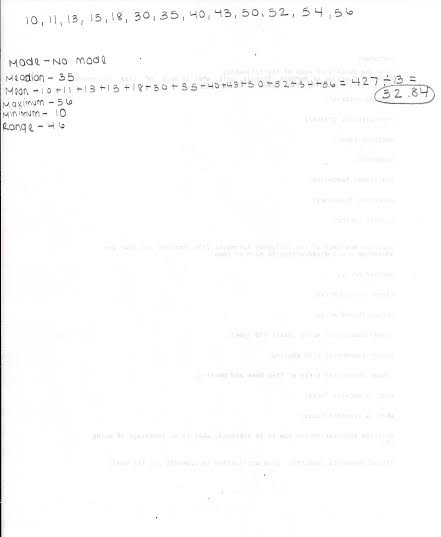
Below I have the data that I collected from happiness is pets.com. There I recorded the weights of many different dogs.


Bittie- Pitbull terrier- 50lb
Brita- American Staffordshire Terrier- 40 lb
Josie-  Pitbull mix- 43 lb
Luigi- Border Terrier mix- 10lb
Rico- Lab mix- 56 lb
Una- Pitbull terrier mix- 30lb
Winona- Pitbull mix- 35 lb
Mookie- Shepherd mix- 54 lb
Rock- Shepherd mix-52 lb
Mario- Cairn terrier mix- 13lb
Franny- Cairn terrier mix- 11lb
Herman Chihuahua- 15lb
Shiba Inu- 18lb

I then found the central tendencies of my data.  
central tendecies


I drew out a box and whisker plot showing my data also.


I also calculated the standards deviation of my data. The Shiba Inu is only 18 LBS. This means it is 17.66 standard deviations below the mean of 32.84.
standard deviation.jpg

Wednesday, September 17, 2014

Blue-Tailed Skink

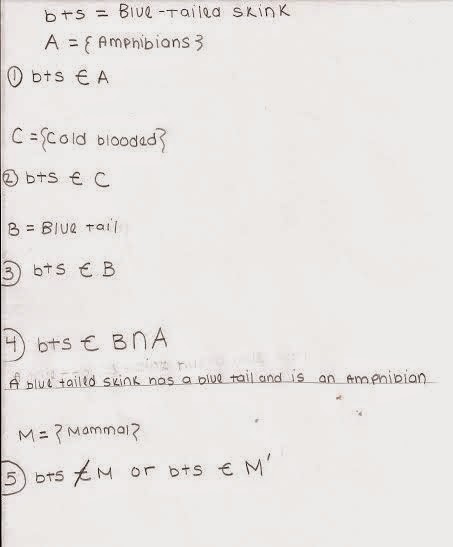
In Unit 1 in the Population class which is called In/Out, the class learned about many different organism's characteristics, and taxonomy,which is the way scientist classify organisms. In math, the class learned about elements in math, which is putting a collection of things into groups. For our first action project the class was assigned to pick an organism and research its characteristics and how its classified. Along with that, we were assigned to create a collage mosaic representing those characteristics. We then partnered up with someone and compared each other's organisms to create a Venn diagram. For the math portion, we had to come up with 5 math statements about our organism. I decided to research the Cryptoblepharus egeriae, also known as a Blue-tailed skink. Below is a table describing the Skink’s taxonomic levels and characteristics.


Taxonomic Level
Blue-tailed Skink Group
Key characteristics of group
Kingdom
Animalia
Multicellular
Eat things
Phylum
Chordata
They have a tail
Class
Reptilia
Have scales rather than feathers
Order
Squamata
Lizards can pop off their tail so it can distract a predator, and they can get away.
Family
Scincidae
Skinks are covered by smooth, shiny cycloid scales giving them a shiny appearance
Genus
Cryptoblepharus
from the top, the skink looks like a snake
Species
C. egeriae

small with a black body with yellow stripes with a blue tail                                                                                                                                                                                                                           


I then created my collage mosaic, where I tried to include every characteristic in the table above. I enjoyed putting together this collage, especially the blue tail because I find it very interesting how this skink has the ability to pop it off when being attacked, or when being chased down for food as a way of distracting its predator.


RD, Blue-tailed skink. (2014) Photography

I created 5 math statements showing which set or group my organism does and doesn't belong in.


RD, Math statements, (2014). Photography


I partnered up with JV who had a Mexican Mole Lizard and we compared each others organism below. We also decided to partner up with AMK who had a Fennec Fox.

RD,JV,AMK. Venn Diagram. (2014). Photography.