In unit 2 in the Population class, which is called From/to, the class learned about the many differences that animals carry. We also went through Darwin and his theories on Natural Selection. The class went through the debate on evolution also. For our second action project we were assigned to choose an animal that we think will survive in Mars, based on the animal’s different traits. We made a video, saying why we think this animal will survive, and be the best fit for Mars. This also went over the topic of how some animals are more fit than others, which gives them a better chance to survive wherever they’re put. For the math portion of this unit, we went over central tendencies, box and whisker plot, and standard deviation. To include those in this project, we were assigned to choose an animal from a petshop and record data of the same species. I had a difficult time choosing an animal and figuring out why they would be the best fit, but after researching everything went well after. The math portion was easy once I collected all the data because the class would go over those topics until we were all confident with it. Thanks to this unit, I now have a more clear understanding of how the many different traits that animals carry help them survive, and be more fit than other animals.
Mars is a dusty, dry, and cold place. But underneath all the rocky surface there is ice. That means that there at least had to be some source of water at some time. Scientist are wondering still if the ice came from precipitation or if it bubbled up from a surface. As scientist began their research, they discovered that Mars could have once been a tiny snow globe. The far distance from the sun is a result of the harsh, cold weather. Also Mars having no clouds to trap heat in results in cold weather ,too. Mars is covered with rocks and ice caps. With that being said, an animal with a thin fur coat would not be strong enough to handle the climate. Also the thinner the animal, the less it would be protected. Chubby animals have more fat on them to keep them warm, whereas thinner animals would not have enough fat. Longer hair would also be able to protect the animal like a blanket, while shorter hair wouldn’t be much protection.
I chose a Shiba Inu. This breed is native to Japan’s mountainous area, which means they are good hunters, and do well in cold weather. They are also #4 on the best dogs that adapt well to cold weather, because of their thick fur.
Script:
Many dogs have the ability to adapt well to cold weather, but none do it as good as a Shiba Inu. A Shiba Inu is a great candidate for a chance to go to mars, because of its great ability to easily adapt to the cold weather.The word Shiba means brushwood in japanese, which either is after their hunting terrain or after the brushwood leaves. Although small, they are excellent hunters. Their size actually is beneficial to them, because it gives them better access to harder to get places. They are native to Japan’s mountainous area, which means they’re very used to the cold, and strong enough to handle the conditions that they’ll face.They have a coat that is double coated, with the outer coat being stiff, and straight, while the undercoat is soft and thick. I would place a Shiba Inu, in a location by ice caps. It would be quicker for them to adapt with it, because they have a love for the snow and ice. That also means that while on Mars they would stay active and alert, because of how much physical activity they’ll be gaining while playing by the ice caps.
Below I have the data that I collected from happiness is pets.com. There I recorded the weights of many different dogs.
Bittie- Pitbull terrier- 50lb
Brita- American Staffordshire Terrier- 40 lb
Josie- Pitbull mix- 43 lb
Luigi- Border Terrier mix- 10lb
Rico- Lab mix- 56 lb
Una- Pitbull terrier mix- 30lb
Winona- Pitbull mix- 35 lb
Mookie- Shepherd mix- 54 lb
Rock- Shepherd mix-52 lb
Mario- Cairn terrier mix- 13lb
Franny- Cairn terrier mix- 11lb
Herman Chihuahua- 15lb
Shiba Inu- 18lb
I then found the central tendencies of my data.
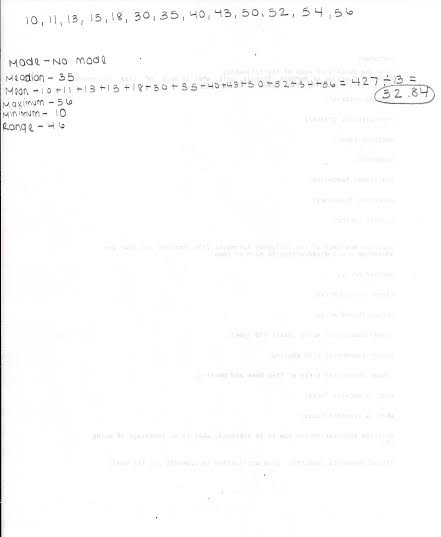
I drew out a box and whisker plot showing my data also.

I also calculated the standards deviation of my data. The Shiba Inu is only 18 LBS. This means it is 17.66 standard deviations below the mean of 32.84.